Random quote of the day:

“The feeling of satiety, almost inseparable from large possessions, is a surer cause of misery than ungratified desires.”

—Benjamin Disraeli, Lothair

satiety4WP@@@

Disclaimer: The views expressed in this random quote of the day do not necessarily reflect the views of the poster, her immediate family, Siegfried and Roy, Leonard Maltin, or the Mormon Tabernacle Choir. They do, however, sometimes reflect the views of the Cottingley Fairies.

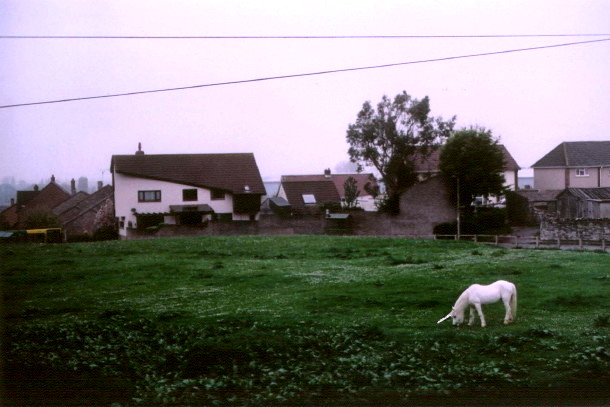
uniquehorn-sm2

Returning once again to my old favorite, Meeting the Other Crowd: The Fairy Stories of Hidden Ireland by Eddie Lenihan and Carolyn Eve Green, to speak of fairy horses, the fíor-làr. There are many, many stories in Celtic lore about horse spirits, but Mr. Lenihan’s informants say that they are generally born to regular mares. There’s some debate what makes a horse fairy instead of ordinary, because to outward appearances they look like any other horse. One story goes that you know you’ve got one of those “funny fish” when the gestation of the foal takes 366 days—the old, magical formula of a year and a day. Most foals gestate in ten or eleven months (according to the old timer telling this story).

Like as not when you have a fairy horse they will be a good horse, but given to disappearing for short spells of time when the fairies require its services. But never fear, the fairies play fair in this regard. If you’re depending on that horse, they’ll substitute another until it’s time for the fíor-làr to be returned to you.

And then there’s this, a more spirit-horse version of fairy horses, taken from The Paranormalist.

He recounts the story told him by author, Herbie Brennan:

Shortly thereafter, as Herbie and Jim turned to leave the rath, along the top of the earthen ring, there suddenly appeared a herd of approximately twenty to twenty-five tiny, white horses “no bigger than cocker spaniels”, in the words of Mr. Brennan. The tiny horses galloped along the top of the earthwork, disappearing down the opposite side. Herbie and Jim ran out of the rath andto the other side to see what had happened to to the tiny horses, but they had vanished. Neither man had any explanation for what they had just seen.

Some years later, Herbie told the story of the white horses to his good friend, the late author Desmond Leslie. Leslie had a fascination with mythology and was quite knowledgeable about the subject. Upon hearing Herbie’s account of the tiny horses, Leslie replied, “Dear boy, don’t you know what those were?”. Herbie replied that he had no idea whatsoever what they were, only that he’d seen them. “Those were faerie horses,” Mr. Leslie continued. “They’re associated with the megaliths of Ireland, and there are also reports of them in Japan.”

You can watch Mr. Brennan himself tell the tale below, the first of three stories that explain how he was very reluctantly convinced in the reality of fairies through personal experience:

I’ll have more to say about “fairy photography” one of these days, but let me conclude by saying that I think anyone who’s been around horses much—and I used to be, although sadly not so much anymore—knows that some horses just are special. Even if they don’t have unexplained disappearances to their credit, are not miniature white glowing spirits, sinister kelpies or what all, some of them do seem to have a touch of the fey. Great, dreamy-eyed beasts that they are, they often have their heads in two worlds at once and seem to know much more than the two-leggers astride them. Old souls or fairy-led, I cannot say. Just that they are special.

Random quote of the day:

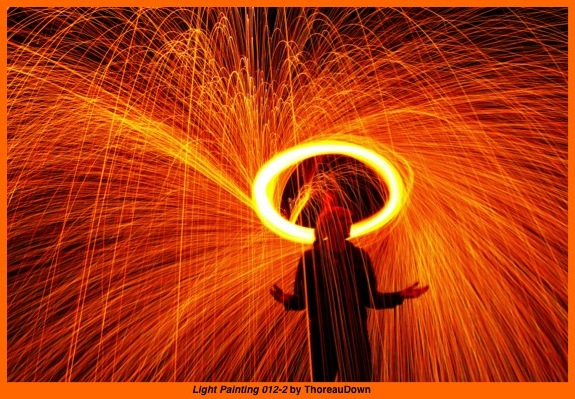
“This universe, which is the same for all, has not been made by any god or man, but it always has been, is, and will be an ever-living fire, kindling itself by regular measures and going out by regular measures.”

—Heraclitus, Fragment 20

phoenix4WP@@@

Disclaimer: The views expressed in this random quote of the day do not necessarily reflect the views of the poster, her immediate family, Siegfried and Roy, Leonard Maltin, or the Mormon Tabernacle Choir. They do, however, sometimes reflect the views of the Cottingley Fairies.

Random quote of the day:

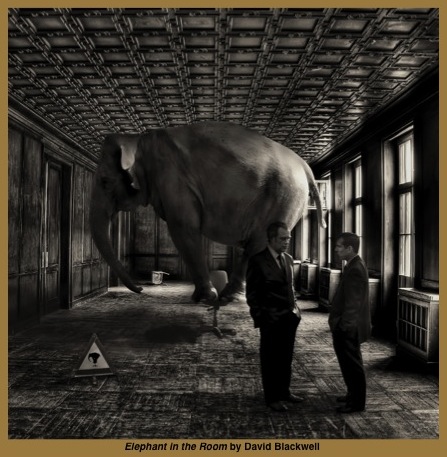
“Isn’t that what life is, after all? Missing something that’s right before you?”

—William Gaddis, interview, The Paris Review, Winter 1987, No. 105

elephant4WP@@@

Disclaimer: The views expressed in this random quote of the day do not necessarily reflect the views of the poster, her immediate family, Siegfried and Roy, Leonard Maltin, or the Mormon Tabernacle Choir. They do, however, sometimes reflect the views of the Cottingley Fairies.

Random quote of the day:

“You can’t change someone’s mind if they don’t have one.”

—Bill Maher, Real Time With Bill Maher, October 2, 2009

mindhole4WP@@@

Disclaimer: The views expressed in this random quote of the day do not necessarily reflect the views of the poster, her immediate family, Siegfried and Roy, Leonard Maltin, or the Mormon Tabernacle Choir. They do, however, sometimes reflect the views of the Cottingley Fairies.

Random quote of the day:

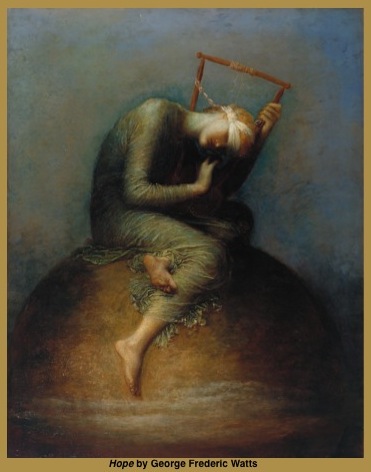
“Hope and imagination are the only consolations for the disappointments and sorrows of experience.”

—Italo Calvino, Six Memos for the Next Millennium

hope4WP@@@

Disclaimer: The views expressed in this random quote of the day do not necessarily reflect the views of the poster, her immediate family, Siegfried and Roy, Leonard Maltin, or the Mormon Tabernacle Choir. They do, however, sometimes reflect the views of the Cottingley Fairies.

Random quote of the day:

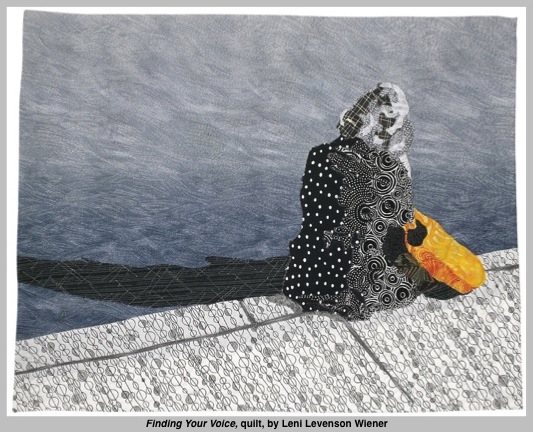
“You kind of evolve into your voice. Or maybe your voice is out there, waiting for you to grow up.”

—Tom Waits, interview, National Public Radio, March 1, 2011

voice4WP@@@

Disclaimer: The views expressed in this random quote of the day do not necessarily reflect the views of the poster, her immediate family, Siegfried and Roy, Leonard Maltin, or the Mormon Tabernacle Choir. They do, however, sometimes reflect the views of the Cottingley Fairies.

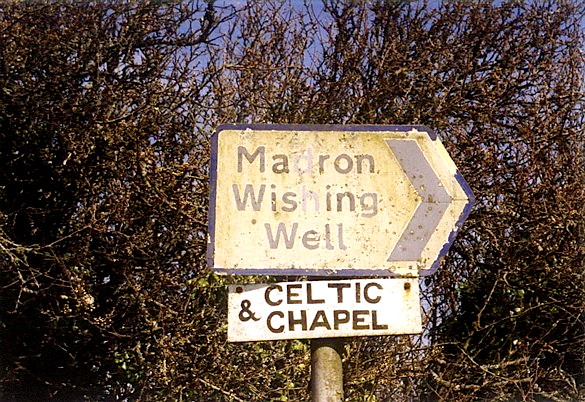
1st. madron sign

Back in 2004, two friends and I visited the Cornish peninsula. Tintagel was definitely a high point—the actual rock and castle itself, if not the village. But there was another place that left just as big an imprint on my soul—maybe even bigger. Not as dramatic as Tintagel, much quieter, but no less magic: St. Madron’s Holy Well in Cornwall.

It’s inland from Penzance only a few miles, but a whole different world from the bustling tourist centers along the coast. It wasn’t featured prominently in my Green Guide, but I’d read about the well elsewhere and it figured high on my wish list. My companions indulged me in this, and I think they were glad they did. We were an Episcopalian, an agnostic, one leaning strongly towards pagan, and all of us were all moved by this place. It’s been holy since pagan times, taken over by the Christians, and still remains holy to both. There are a couple of small churches nearby, St. Madron’s which we didn’t get to visit, and St. Grada—small, lovely, peaceful. But the well itself (and the ruined chapel channeling it) exist a mile north and a whole ‘nother universe apart.
2burning blossoms

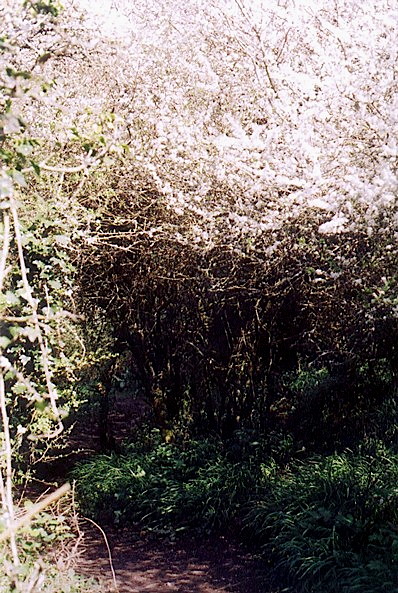
It’s a half-mile, so they say, from the church to the gate leading to the well, and a quarter mile in to the ruined chapel. Pastures surround the location, and the gate opens onto a tree-lined path. On this spring day, the trees burned with blossoms. We progressed through dappled shade along the rough path, delicate wildflowers in white and pink and yellow leading the way. Maybe it’s the screen of trees that shuts off all noise except the chirping of birds, the occasional movement of wild things in the overgrown brush on either side, but it’s like stepping into another world, so different from the one we know—centuries older, maybe a millennium or two. We hushed in response, the sound of our quiet passage seeming unnaturally loud. We could hear the wheels of our own thoughts spinning in our heads.

7madron stream

It hadn’t rained for several days, but the path was still damp, quite muddy in spots, sunken beneath water in places. Sometimes we had to scramble over rough stiles, crudely cut blocks of gray stone. One to step up, a flat one to scramble over, one to step down.
10holy well

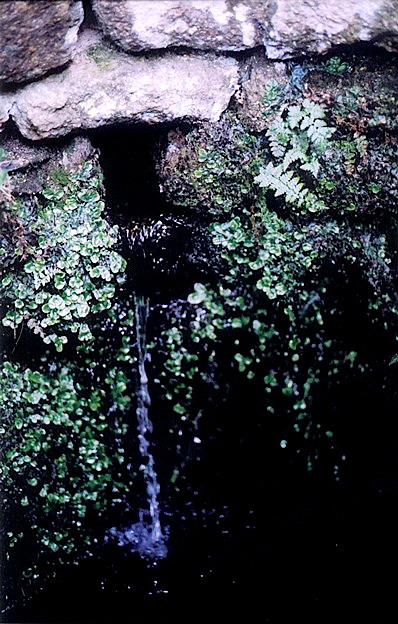
The waters of the wellspring, I learned later, is somewhere out in the marshy land beyond the chapel, but they say its water brings healing and also gives mystical insight into the future. Puritan fanatics tried to smash the well housing in the chapel during the Civil War, but it still burbles on with fresh, pure, clean water. We were there on a Saturday, the end of April, but the waters are supposed to be their most potent on the first three Sundays in May. Maybe we got some residual from the build up to May, who knows?
5madron rag offerings

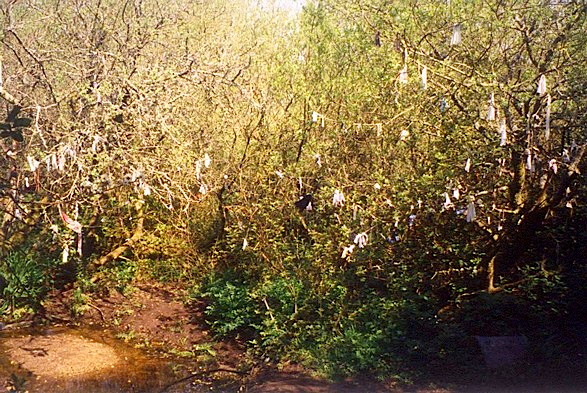
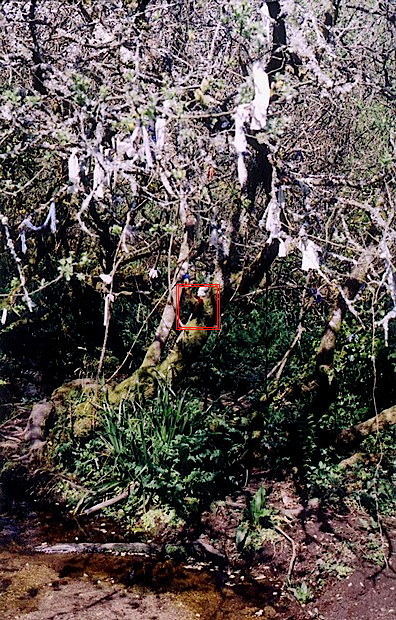
After the second stile and down a bit, there’s a stand of trees where people who’ve been cured by the well leave an offering—traditionally rags tied to the trees, but we saw all sorts of things. We left our offerings before the fact. All I had on me was a crimson velveteen scrunchie for my hair, one I was particularly partial to. I must say it looked lovely wrapped around the broken end of a branch.
6my red velvet offering_box

A real presence exists in that place, a sense that something potent moves through those trees. I didn’t feel at all silly looking back on that crimson scrunchie. It felt damned good, an elevation of the spirits. No guarantees of anything, no promises made, but for me a sense that I was making a wordless promise; I gave up something to the spirit of the place.

I’m not exactly sure why that particular bend in the stream became the location of the rag offerings because it’s around the path and down a ways from the actual well site. But I do know that the stream forked at this point, and in pagan beliefs, at any rate, forks in rivers are magical places. As are forked trees—ymp trees, they’re called, where the branches split in a Y low enough on the trunk for a human to walk or climb through easily. There were some of those in that grove, too. Forks represent transition points, places where the energy (or magic) changes directions and, some believe, gives a surge of power.
8path to chapel

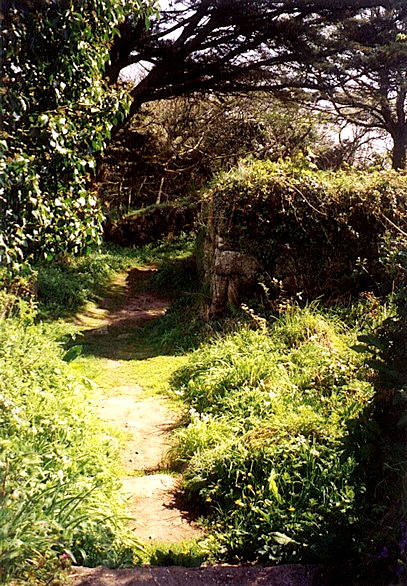
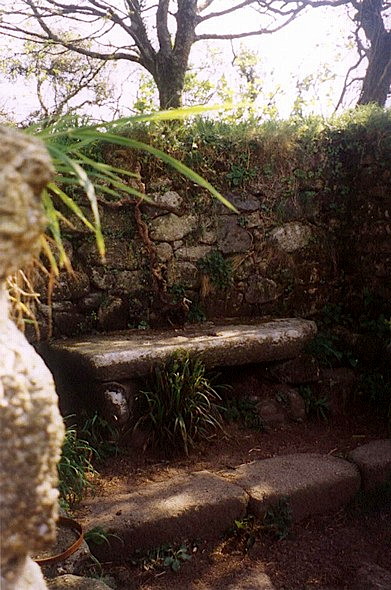
The chapel itself is a ruin, a roofless box of ancient stone, steeped in age and covered in moss. An altar, on this day hosting a crude cross woven of branches, sits at one end of the enclosure.
11interior, altar

The interior housing for the well is another, smaller box on the opposite side, with a catch basin for the waters before they flow out and into the stream. A cold, absolutely clear, surprisingly gentle stream for such a volume of water—and again, the sense of presence was palpable. Even if you don’t go in for the mystical stuff, the thought that for thousands of years humans have come to this spot for prayer and offerings is awe-inspiring. Maybe that’s all the presence is at Madron, those innumerable human lives and energies intersecting with this place. Whatever it is, it’s potent. We sat on the rough stones for longest time, drinking it in, letting the peace invade our souls and smooth out the jangles. I was healed, although I hadn’t been aware of being sick.

I snapped a few pictures, but it seemed a futile (and maybe sacrilegious?) endeavor, and none of them came out all that well. I couldn’t escape the realization that no film, no picture could capture the enveloping green peace of this place, surrounded by trees, accompanied by the trill of songbirds, the plash of water on stones, the gurgle of it running in a channel, the fresh smell of greenness all around. At best, these photos may jog memories years hence, opening the door to the soul memory left behind by St. Madron’s Well.
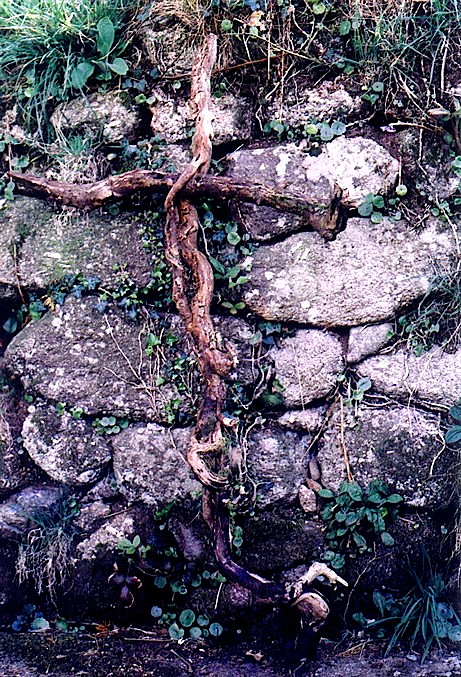

13cross on altar

Random quote of the day:

“You can hear the footsteps of God when silence reigns in the mind.”

—Sri Sathya Sai Baba, quoted in Sathya Sai Teachings by Dr. Purushothaman

footsteps4WP@@@

Disclaimer: The views expressed in this random quote of the day do not necessarily reflect the views of the poster, her immediate family, Siegfried and Roy, Leonard Maltin, or the Mormon Tabernacle Choir. They do, however, sometimes reflect the views of the Cottingley Fairies.

Random quote of the day:

“In each generation we see sparks which we ignore just because they don’t fit into our picture of science or knowledge.”

—Isaac Bashevis Singer, The Paris Review, Fall 1968, No. 44

sparks4WP@@@

Disclaimer: The views expressed in this random quote of the day do not necessarily reflect the views of the poster, her immediate family, Siegfried and Roy, Leonard Maltin, or the Mormon Tabernacle Choir. They do, however, sometimes reflect the views of the Cottingley Fairies.

« Previous PageNext Page »