writing


Here’s the entire excerpt for today’s quote.  I liked it so much I thought you might like to see it in full.  The letter was quoted in Raymond Chandler Speaking.

May 25, 1957
To: Helga Greene
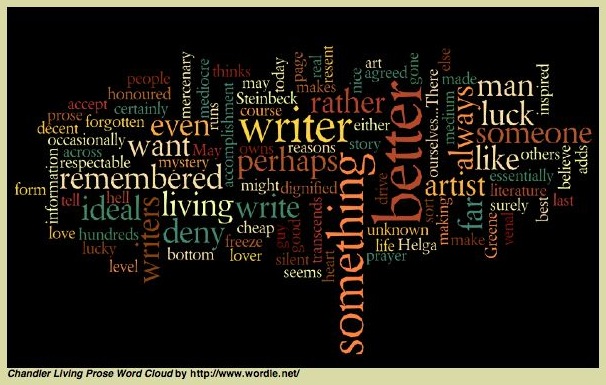
…To accept a mediocre form and make something like literature out of it is in itself rather an accomplishment.  They tell me—I don’t say this on my own information—that hundreds of writers today are making some sort of living from the mystery story because I made it respectable and even dignified.  But, hell, what else can you do when you write?  You do the best you can in any medium.  I was lucky, and it seems that my luck inspired others.  Steinbeck and I agreed that we should like the writer who is to be remembered and honoured after we were gone to be some unknown, perhaps far better than either of us, who did not have the luck—or perhaps the drive.  Any decent writer who thinks of himself occasionally as an artist would far rather be forgotten so that someone better might be remembered.  We are not always nice people, but essentially we have an ideal that transcends ourselves…There are, of course, cheap and venal writers, but a real writer always at the bottom of his heart, when he runs across something good, makes a silent prayer that “this guy may be better than I am”.  Any man who can write a page of living prose adds something to our life, and the man who can, as I can, is surely the last to resent someone who can do it even better.  An artist cannot deny art, nor would he want to.  A lover cannot deny love.  If you believe in an ideal, you don’t own it—it owns you, and you certainly don’t want to freeze it at your own level for mercenary reasons.
Random quote of the day:

“Any man who can write a page of living prose adds something to our life, and the man who can, as I can, is surely the last to resent someone who can do it even better.  An artist cannot deny art, nor would he want to.  A lover cannot deny love.”

—Raymond Chandler, letter to Helga Greene, May 25, 1957

Disclaimer:  The views expressed in this random quote of the day do not necessarily reflect the views of the poster, her immediate family, Siegfried and Roy, Leonard Maltin, or the Mormon Tabernacle Choir. They do, however, sometimes reflect the views of the Cottingley Fairies.

I always put a date in the filename when I start a new draft of a novel as a convenient reference for when I started, then tend to gloss over them and ignore them as irrelevant.  I just looked at the date on the file for the first draft of Venus in Transit: June 26, 2009.  That means I spent just about a year on the damned thing.  I would have sworn I was at least at the year and a half mark.  It seemed interminable.  It was a longer time span than other recent novels have taken to produce a first draft, and it was interminable, but dang.  I’m surprised.

Oh, and I was able to leave the draft alone for one whole day in order to fix up and post a short story I wrote about a month ago.  I woke up this morning itching to do the read-through on Venus.

I apparently have my writing Jones back.

Talk to me again when I’m halfway through the read-through.  My attitude may have altered somewhat.

Random quote of the day:

“Here is a lesson in creative writing.  First rule: Do not use semicolons.  They are transvestite hermaphrodites representing absolutely nothing.  All they do is show you’ve been to college.”

—Kurt Vonnegut, A Man Without a Country


Disclaimer:  The views expressed in this random quote of the day do not necessarily reflect the views of the poster, her immediate family, Siegfried and Roy, Leonard Maltin, or the Mormon Tabernacle Choir. They do, however, sometimes reflect the views of the Cottingley Fairies.

If I do say so myself, it’s cool. But I’d also like to know what you think.

http://www.pj-thompson.com/

F-Bod Studios, aka hominysnark, has done a brilliant job of bringing home the visuals and most of the cool. It’s so pretty! There are a number of fun touches and some hidden goodies.

I hope to start posting some of my fiction soon, perhaps one of my older novels, and a serialized novel, maybe some stories. In the meantime, there are other writings there. I will be posting five poems a month on a rotating basis. As I post them on the website, I’ll be removing them from LJ if I’ve posted them here.

Thanks to those who gave me FAQ questions to answer. Space considerations meant I didn’t wind up using all of them, but I appreciate your efforts.

I was reading Carl Jung’s sort-of autobiography, Memories, Dreams, Reflections yesterday. I like it because it isn’t a typical autobiography—Jung abhorred the very idea of writing one.  It is exactly what the title states: a collection of memories, dreams, and reflections that went to the formation of the person Jung became.  He wanted to peal back the layers of himself to see where his Self came from.  There are many strange and memorable passages.

In yesterday’s memorable passage, he was discussing his teenage years and an elaborate fantasy he used to entertain himself with on walks to and from school, a kind of alternate reality where all of the Alsace was one giant lake:

There would be a hill of rock rising out of the lake, connected by a narrow isthmus to the mainland, cut through by a broad canal with a wooden bridge over it, leading to a gate flanked by towers and opening into a little medieval city built on the surrounding slopes.  On the rock stood a well-fortified castle with a tall keep, a watchtower.  This was my house.

He goes on to describe a rather neat and spare little tower, with small but comfortable rooms, weaponry, canons, men-at-arms, and a great library “where you could find everything worth knowing.”

The nerve center and raison d’être of this whole arrangement, he goes on to say, was the secret of the keep, which I alone knew….Inside the tower, extending from the battlements to the vaulted cellar, was a copper column of heavy wire cable as thick as a man’s arm, which ramified at the top into the finest branches, like the crown of a tree or—better still—like a taproot with all its tiny rootlets turned upside down and reaching into the air.  From the air they drew a certain inconceivable something which was conducted down the copper column into the cellar.  Here I had an equally inconceivable apparatus, a kind of laboratory in which I made gold out of the mysterious substance which the copper roots drew from the air….One was not supposed to look into it too closely, nor ask what kind of substance was extracted from the air….What the roots absorbed and transmitted to the copper trunk was a kind of spiritual essence which became visible down in the cellar as finished gold coins.  This was certainly no mere conjuring trick, but a venerable and vitally important secret of nature which had come to me I know not how and which I had to conceal not only from the council of elders but, in a sense, also from myself.

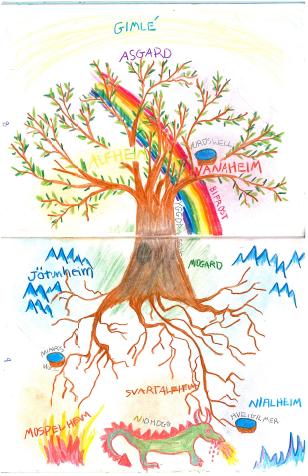
This reminds me of Yggdrasil, the Norse Tree of Life, which Jung possibly had rattling around in his Germanic subconscious, but I like his actualization of the concept. I couldn’t help thinking what a terrific idea this was, that perhaps I should “steal” it (with full and proper attribution, of course) and adapt it.  I’m not much of a high-fantasist, alas, and I’ve become somewhat disenchanted with steampunk, so I don’t really know what I am these days, except perhaps the crock at the end of the rainbow, sans the gold.

Jung goes on to say, This highly enjoyable occupation lasted for several months before I got sick of it.  Then I found the fantasy silly and ridiculous.

Ah, I thought.  Mid-novel ennui.  I know that well enough.  If any of you would like to “adapt” this idea yourselves, please remember to pay homage to Carl Jung’s imagination.

There are many images of Yggdrasil, but I like the one below best, done by one of the students at Emerson Waldorf School, Chapel Hill, NC.

B

Bureaucracy, n., A system set up to help large institutions waste the time, resources, and lifespans of individuals.


*With apologies to Ambrose Bierce.

« Previous Page